
Distilling Essential Oil on a Small Farm:
A Look Inside the Process at South River Lavender
There’s something quietly remarkable about distilling essential oil. The equipment is simple, the process is ancient, and the result, a modest amount of concentrated plant essence, feels disproportionately valuable for how straightforward the process is. I’ve been distilling lavender, rosemary, and eucalyptus oil in our farm workshop for ten years and it still holds a kind of reverence and fascination I didn’t expect when I first started.
Here’s a look at how I got here, how the process works, and what goes into producing a good yield.
A Process with Deep Roots
Steam distillation as a method of extracting essential oil dates back over 2,000 years. Egyptian alchemists are credited with developing the copper “alembic” design — a still with a storied history that wound its way through Greek, Roman, and Arab civilizations before arriving, more or less intact, in farm workshops like mine. Scientists have spent centuries confirming what earlier cultures understood intuitively: that the aromatic compounds in plants carry genuine therapeutic and sensory value. One interpretation, more mythological than scientific, describes essential oils as the vital life force of a plant, something close to its spirit.
Whether you take that literally or not, there’s something about the ancient distillation process that feels hypnotic when you’re standing over a hand-hammered copper still, imported from Portugal, waiting for steam to rise and separate a fragrant oil from dried plant material.
How I Got Started
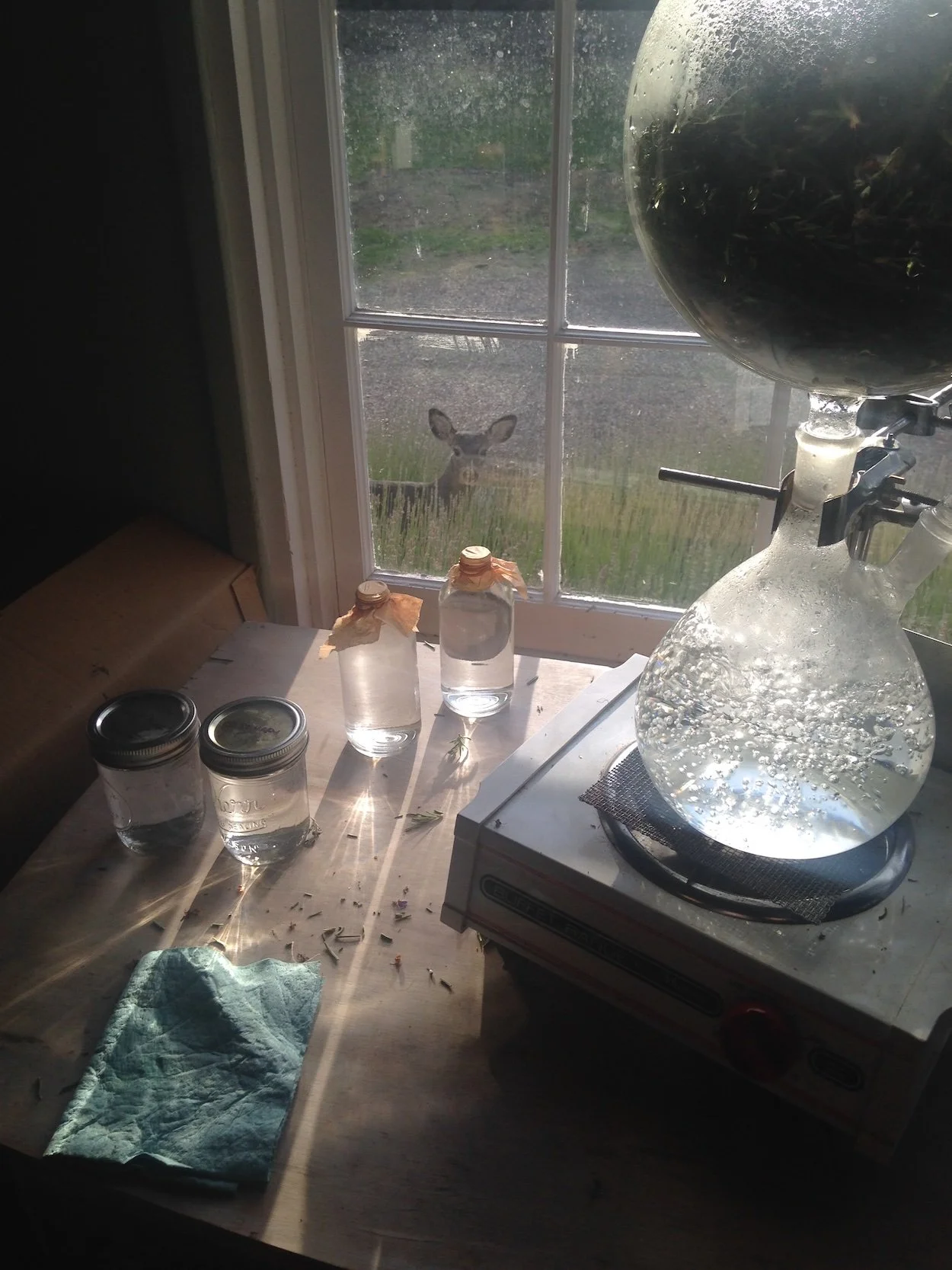
My distillation journey started with a small glass science lab setup that was given to me by the previous owners of the farm. They’d stopped using it, they said, because it didn’t yield much oil and was difficult to clean. I found, with some experimentation and the addition of a few larger glass components, that it worked better than expected. Careful attention to plant preparation and steam timing made a real difference in quality.
As my fascination with distillation grew, so did my curiosity about more traditional methods. That’s what eventually led me to the world of copper alembic stills, the same ancient design that alchemists refined over centuries. Making the switch felt like joining something much larger than a hobby. Even though the equipment itself is relatively simple, becoming part of that historically revered process is genuinely gratifying in a way that’s hard to fully explain.
How the Distillation Process Works
The basic principle of steam distillation is straightforward: steam rises from boiling water through dried plant material, which causes the essential oil cells to rupture and release their aromatic compounds. The steam carries those compounds up through the still coil, where they cool, condense, and separate, oil floating on top of the collected water, which is itself fragrant and useful as a floral hydrosol.
What sounds simple requires careful attention in practice. Plant material needs to be handled properly before it goes into the still; harvested at the right time, not wet, not too dry. Temperature and timing both matter. Too much heat too fast and you lose volatile top notes. Too slow and yields drop. A good distillation run is less about following a rigid formula and more about paying attention and adjusting as you go.
The Oil
I distill three very different plants for their essential oil; lavender, rosemary and eucalyptus in small batches.
Lavandin is my primary oil product, produced from the Grosso variety that was bred in the 1960’s in Provence for the essential oil industry. Lavandin oil has a robust, full-bodied aroma that is more intense than English lavender, and it's the variety most commonly used in soaps, sachets, and aromatherapy products for that reason. A little goes a long way.
Rosemary oil has a sharp, herbaceous quality and a long history of use in everything from culinary applications to hair and scalp care and memory retention. Rosemary grows alongside the lavender and shares the same well-drained, sunny conditions. It gives the bees forage in the winter months too.
Eucalyptus rounds out the collection with a clean, bright, distinctly medicinal aroma. It's a natural fit for my Sierra Foothill collection, where baby blue gum eucalyptus grows rapidly and tolerates the dry summer heat without complaint. Many customers come by my cart at the market to smell the invigorating eucalyptus oil aroma to clear their sinuses on a cold morning.
All three oils are available at my Amador County Farmers Market stand throughout the season in 10ml glass bottles.
What Makes a Good Yield
Yield in essential oil distillation is never guaranteed. It depends on the plant variety, the harvest and drying timing, the quality of the plant material, and the care taken during the distillation run itself. Lavender that’s been cut too late, dried improperly (moldy), or distilled too long (too much heat), will produce less oil and a less complex aroma than plant material that’s been handled with attention at every step. Ultimately, essential oil quality is about how it smells after it has been aged in a glass container with a cheese-cloth cover to aerate for a few months.
What I’ve found, after years of trial and error, is that the quality of the oil is determined long before the still is ever heated up. It starts in the field.